Cruising on the American Queen Steamboat
By
Benjamin S. B. Lyons
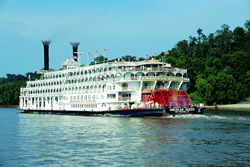 Appearing
from behind a thick scrub brush with a line that once connected the steamboat
to a sturdy oak tree, the deckhand jumped onto the gangway suspended over the
riverbank just as the American Queen started backing into the river. Waving goodbye
to us from the shore was a small crowd of little kids seeing a steamboat for the
first time and grandparents who have seen it numerous times before. As we started
slowly churning up the Mississippi River, our steam calliope began festively serenading
them and the retreating town as we journeyed upriver. Appearing
from behind a thick scrub brush with a line that once connected the steamboat
to a sturdy oak tree, the deckhand jumped onto the gangway suspended over the
riverbank just as the American Queen started backing into the river. Waving goodbye
to us from the shore was a small crowd of little kids seeing a steamboat for the
first time and grandparents who have seen it numerous times before. As we started
slowly churning up the Mississippi River, our steam calliope began festively serenading
them and the retreating town as we journeyed upriver.
Sailing
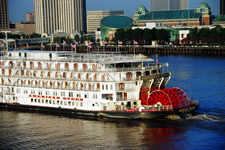
through the vast interior waterways of the United States, the American Queen is
one of the last three steamboats offering overnight passenger service to a little-seen
side of America as well as a taste of the days of Mark Twain. Looking at the steamboat
towering over the river, I felt as if the history books had come alive with an
old steamer still carrying on commerce along the river, unaware that the 21st
century had already arrived.
 Cruising
from Memphis to Cincinnati on the Mississippi and Ohio Rivers, it didn't take
me long to realize that river cruising was different from ocean cruising. At most
ports, there were no docks to tie up to; rather, the boat nestled up against the
muddy riverbank while a crew member jumped ashore to find a tree to tie the boat
up to. Instead of gambling or the beach, the entire trip was based around the
river, which leads further and further into the country while cutting through
vast expanses of open land and forests along with small towns perched on the riverbank.
So mystical and alluring is the river that many of the crew consider it a living,
constantly changing entity. Cruising
from Memphis to Cincinnati on the Mississippi and Ohio Rivers, it didn't take
me long to realize that river cruising was different from ocean cruising. At most
ports, there were no docks to tie up to; rather, the boat nestled up against the
muddy riverbank while a crew member jumped ashore to find a tree to tie the boat
up to. Instead of gambling or the beach, the entire trip was based around the
river, which leads further and further into the country while cutting through
vast expanses of open land and forests along with small towns perched on the riverbank.
So mystical and alluring is the river that many of the crew consider it a living,
constantly changing entity.
Going
upriver, we delighted in watching the river change each day. At first, it was
wide and thickly forested with huge sets of towboats and barges several hundred
feet long sharing the channel. As we went up the Ohio River, it turned green and
hilly, with sleepy villages peeking out from the trees and kids who ran down their
lawn to wave at us as we sailed by, while their mothers slowly trailed behind.
As the
river grew smaller, we seemed to grow larger as we continued our exploration deeper
into the country, winding our way along with the river as was done a few hundred
years ago. America was being paraded in front of us, and it was always fascinating
to step outside and watch a small town going by or peer towards the next bend,
wondering what lies ahead. The further we went, the more and more I felt I was
coming to understand my country as I witnessed parts I had never seen before.
At
night, the river was entirely different, hushed and silent beneath clear, starry
skies and blacked out with only an occasional red or green light on shore marking
the channel. The boat's powerful spot lights would suddenly come on, illuminating
the tangled trees along the riverbank or look ahead and catch the reflection from
the next marker. Sometimes, coming around a bend, all you could see from a downriver
boat would be its searchlight, blindly trying to feel its way, before minutes
later finally seeing its barges appear from behind the trees.
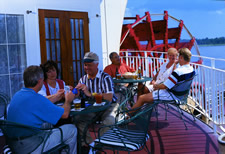 Impressively,
the pilots in the wheelhouse continue to know the river the way Mark Twain did
- all by memory, and they continually guide the boat from one bank of the river
to the other, knowingly finding the deeper waters and the lesser currents. Quite
simply, until you've been on the river, it is impossible to understand its serenity
and fascinating appeal, and far from being boring, sitting on the boat's rocking
chairs or a porch swings watching the river go by is infinitely satisfying. Impressively,
the pilots in the wheelhouse continue to know the river the way Mark Twain did
- all by memory, and they continually guide the boat from one bank of the river
to the other, knowingly finding the deeper waters and the lesser currents. Quite
simply, until you've been on the river, it is impossible to understand its serenity
and fascinating appeal, and far from being boring, sitting on the boat's rocking
chairs or a porch swings watching the river go by is infinitely satisfying.
Most
port calls reflect a simpler way of life, with some small towns having only a
few thousand residents and one Main Street forming the center - and extent - of
the town. With these towns built around the river, the boats land you right in
the city center - it is usually only a few steps from the landing on the riverbank
to Main Street. There are few bona-fide attractions in many ports; New Madrid,
Missouri's main claim to fame was a large earthquake that took place 190 years
ago, while in Paducah, Kentucky, the biggest attraction is the National Quilt
Museum. Having the steamboats tie up at their town is a big event and the friendly
locals often come down in crowds to welcome the boats or watch them sail.
Each
Delta Queen steamboat has a Riverlorian, or river historian, who shares his or
her extensive knowledge of the river and its history, helping connect passengers
to their surroundings. Happily, the American Queen seemed an integral part of
it all and fitted in perfectly, with everyone on the rivers having heard of these
steamboats. With their all-American crew, the boats are a slice of American life
and have a real national identity.
Full
of spirit, the crew is some of the most colorful and genuine that you'll find
on any ship. Friendly and cheerful, and often times extraordinarily funny, many
consider the boats home after serving onboard for over a decade and they did whatever
they could to make each day special. One day, we had a picnic onboard, and discovered
the dining room changed with table covered in red and white checkerboard tablecloths.
Dressed in jeans, suspenders, blue denim shirts and cowboy hats, our waiters strolled
around serving us corn, chicken, catfish and ribs while a busboy might walk around
sprinkling plastic ants all across the table while crooning, "Its just like
a real picnic, isn't it?"
The
food was also surprisingly good, and had a southern and Cajun influence. Traditional
river specialties like Catfish and Jambalaya are done superbly, and nightly bread
pudding, in addition to always-available freshly popped popcorn, baskets of chocolate
chip cookies and a self-serve soft ice cream machine ensured we didn't lose any
weight.
For
those who want more to do than simply watch the river, the boats do come up with
a slew of activities, mostly along the lines of the 'good old-fashioned fun' type.
One of the most popular is kite flying, when passengers spend an hour coercing
their kite to soar above the river, with one eye on the lookout for upcoming bridges.
Talks on the river and its history are also a big draw, and frequent theme cruise
topics include the Civil War, Lewis and Clark expeditions, a Bluegrass Jamboree,
the Southern Culture and Steamboat Races, where two of the boats will race over
an entire cruise.
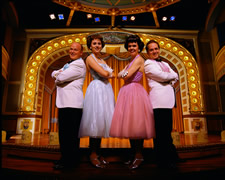 With
the company based in New Orleans, musical entertainment is taken seriously and
is universally excellent. There always seems to be some music playing throughout
the day: A first rate Dixie, Big Band and Ragtime band played in the Grand Saloon
nightly for dancers and a pianist drew large crowds for her 'easy-listening' music
while a witty and clever Banjo player held court in the intimate Engine Room Bar
which features windows overlooking the spinning paddlewheel. From vaudeville acts
of the 1920s to sing-alongs in the bar, the entertainment is lively and always
fun. With
the company based in New Orleans, musical entertainment is taken seriously and
is universally excellent. There always seems to be some music playing throughout
the day: A first rate Dixie, Big Band and Ragtime band played in the Grand Saloon
nightly for dancers and a pianist drew large crowds for her 'easy-listening' music
while a witty and clever Banjo player held court in the intimate Engine Room Bar
which features windows overlooking the spinning paddlewheel. From vaudeville acts
of the 1920s to sing-alongs in the bar, the entertainment is lively and always
fun.
Once
you've decided to cruise with Delta Queen, choose where in the country you want
to sail first and then choose your boat. Sailing from 11 major embarkation points
ranging from New Orleans to St. Paul to Pittsburgh and everything in-between,
the steamboats truly traverse the nation's interior.
On the Lower Mississippi
from New Orleans to just above Memphis, the riverbank seems mostly deserted, with
forests and an astounding amount of towboat traffic forming the bulk of sightseeing.
The boats stop right at former and current plantations, and passengers visit beautiful
antebellum homes and learn more about the Civil War era.
The
Upper Mississippi from St. Louis to St. Paul is "America's Heartland" and features beautiful, rolling hills and gentle farmlands, and Fall Foliage cruises
in September and October are probably the most beautiful trips available on the
river. The Wilderness Rivers, including the Ohio River stretching east all the
way to Pittsburgh, Pennsylvania, roll right past small towns and communities,
as if the boat is cutting through their backyards. These rivers are where steamboats,
and much of America, got its start, and the history is still easily accessible.
 New
in 2004 will be the American Queen sailing a series of three and four night cruises
out of New Orleans. In attempt to lower the average age of passengers slightly
and introduce Steamboatin' to a broader market, the boat will try and liven up
the activities and the shore excursions onboard as well as possibly offer pre-
and post- cruise golf packages, and despite virtually nonexistent children's facilities,
a few families can be expected next year. New
in 2004 will be the American Queen sailing a series of three and four night cruises
out of New Orleans. In attempt to lower the average age of passengers slightly
and introduce Steamboatin' to a broader market, the boat will try and liven up
the activities and the shore excursions onboard as well as possibly offer pre-
and post- cruise golf packages, and despite virtually nonexistent children's facilities,
a few families can be expected next year.
The
boat you sail on is just as important as your itinerary, with each one having
a distinct personality. The Delta Queen, built in 1926 and featuring an all-wooden
superstructure, is a National Historic Landmark that attracts a following as loyal
as can be found anywhere. Small, intimate and utterly charming, the Delta Queen
is often compared to a warm B&B and is one of the most wonderful cruising
experiences found anywhere. As on the American Queen, most of the cabins open
up directly onto communal decks, which helps to create a neighborly feel and adds
to the naturally friendly spirit found onboard.
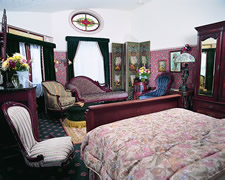 The
Mississippi Queen and the American Queen were built in 1976 and 1995 respectively
and are larger and feature some modern amenities like small pools or verandah
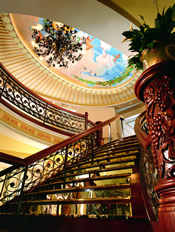
cabins. The American Queen, in particular, is a virtual museum piece built with
an almost unlimited budget, adorned with antiques, superb reproductions and a
two-storied dining room that perfectly recreates the ornate "Floating Palaces"
of the past. In fact, everywhere on the boat you look you find an extraordinary
amount of detail and design, including antique dressers in cabins, carved wooden
banisters and molded ceilings with trim. The
Mississippi Queen and the American Queen were built in 1976 and 1995 respectively
and are larger and feature some modern amenities like small pools or verandah
cabins. The American Queen, in particular, is a virtual museum piece built with
an almost unlimited budget, adorned with antiques, superb reproductions and a
two-storied dining room that perfectly recreates the ornate "Floating Palaces"
of the past. In fact, everywhere on the boat you look you find an extraordinary
amount of detail and design, including antique dressers in cabins, carved wooden
banisters and molded ceilings with trim.
By
the time we reached Cincinnati, I was totally relaxed - this was one trip where
I didn't need a vacation after my vacation to rest up. Life seemed to slow down
to the boat's sluggish but hypnotic pace up the river, and all the passengers
fell under the river's spell.
Nowhere
was this spell felt more strongly for me than when I would finish my night by
taking a walk back to the brightly lit red paddlewheel. Spinning
with a steady, rhythmic slapping of the water that created a reassuring sound
as the darkened shore slipped by, I found myself thinking of steamboats of the
past while hoping that this paddlewheel will turn forever, magically caught in
another era.
|