See the Natural Beauty of America's West
by Luxury Train
By
Suzanne Carmel
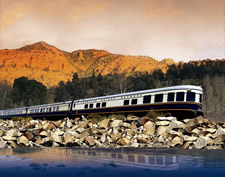 |
American
Orient Express in Arizona.
photo courtesy of AOE |
The sounds of animated chatter and clinking flutes of champagne welcome guests to
the Grand Salon of the esteemed Grand America Hotel in Salt Lake City, Utah.
As
the group mills about, nametags firmly in place, "golden railers" who
have taken a similar journey before greet the uninitiated and each other. We're
about to begin a week-long exploration of the national parks of the West onboard
the American Orient Express (AOE), a privately-owned 16-car luxury train. The
sense of anticipation is palpable; the setting elegant. We already seem to be
stepping back in time to an era when an important part of travel was the journey
itself.
Beginning
a rail trip out West in Salt Lake City seems a bit ironic, given that the capital
of the Beehive State (dubbed "beehive" for the industrious Mormons who developed
this area) is one of the only cities out West that does not owe its development
to the railroad. During our half-day tour, one cannot help but marvel at the Temple
Square, a symbol of the religious freedom many came here to enjoy. Today, less
than 40 percent of Salt Lake City is Mormon, but 70 percent of the state practices
this faith. The city is worth a visit and a convenient point of embarkation
for the train.
Utah
is home to both Zion National Park and Cedar Breaks Monument, which we'll visit
later in the week. Surprisingly, many passengers have not yet been to any of the
five stops on our itinerary. In addition to the two stops in Utah, we'll visit
three other national parks — Yellowstone, Grand Teton and Grand Canyon. These
five natural treasures owe their first influx of tourists, in part, to the railroad.
According
to Carlos Schwantes, our guest lecturer for the week and an authority on transportation,
few people came out to tour the West before the start of the railroad back in
the 1830's. The railroad realized national parks would draw people out
West and made it possible to get to these attractions. It issued millions of brochures
promoting national parks and built many of the park lodges. Once
the automobile arrived on the scene, people stopped taking trains to the parks.
Today, few people take a leisure trip via train. A majority of the railroad business
is hauling freight and, on occasion, the American Orient Express. It's the only luxury passenger train
in the country, with the exception of a few corporate, dinner and excursion trains.
All Aboard
Where else can you travel and have an entire staff lined up to greet you? The AOE staff lines up every time passengers board the train - on the first day and upon the return from each day excursion. It's a welcoming touch and an indication of the level of service. We're escorted to our respective cars by the porters who man them and then to our individual cabins.
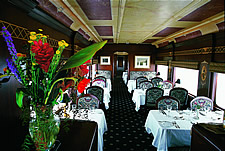 |
Dining car aboard the AOE.
photo: courtesy of AOE |
This week there are only 65 passengers onboard, though the train can sleep as many as 105. During the trip, 50 train staff keep things running smoothly. There is one porter and about ten cabins per car. The porters do everything from scheduling shower times to assisting with things in the cabins, helping haul daypacks to buses and addressing last-minute needs. Rooms are made up every morning and turned down every night. During the day, beds become sofas, but the rooms are so compact most of us would rather watch the passing scenery from the lounge cars or the Dome car.
Except for when in the dining cars, people seem to stick to the part of the train closest to their cabins. It's a bumpy ride on much of the track and the older guests are less sure-footed crossing between cars. Although it's a quarter of a mile from one end of the train to the other, public cars are spread out through the train to give everyone plenty of places to socialize. The Seattle car is the train's entertainment car. A guest pianist plays there every evening before and after dinner. Those who are so inclined can sing along to the medley of tunes and even request personal favorites.
There isn't much to do on the train except watch the scenery, read a good book, play one of the games stocked in the lounges or visit. It doesn't much matter, though, because on this itinerary we're off the train every day, even staying over at a lodge near a national park one night. The point of this trip, and getting there by train, is to slow down and enjoy the journey.
Out West
The wide-open space of the West makes it the perfect place to unwind on a train. Great expanses of open land rush by while the rocking motion lulls us into a relaxed camaraderie. Every morning, after an early breakfast, we pile onto a bus that will take us to our next adventure. Local guides paint an intimate portrait of the land and the flora, fauna and people who shape these natural wonders. As we travel first north to Yellowstone and Grand Teton, and then south to Zion, Cedar Breaks and Grand Canyon, the landscape changes. From mountain peaks to canyon bottoms, flowing rivers to spouting geysers, and prairie dogs to buffalo, there is a sense of timelessness even with a landscape that continues to reinvent itself over and over through time.
Yellowstone became the first national park in the world when President Grant signed a bill making it so in 1872. It's larger than our two smallest states (Delaware and Rhode Island). The Grand Tetons boast 12 peaks in a row over 12,000 feet and are the youngest mountains in North American. In Teton county, the nearby town of Jackson is one of the top 10 richest counties in the United States. The beds of rock in Zion are 180 million years old and the park contains some of the tallest sandstone cliffs in the world. More than 800 native plants, 75 mammals, 36 reptiles and 270 varieties of birds call this park home.
Though Cedar Breaks is a national monument and not a national park, it is far less congested than the more famous Bryce Canyon nearby and affords visitors a panoramic view of a spectacular natural amphitheater below. Cedar Breaks has the highest elevations in Southern Utah, with a summit at 10,400 feet — almost two miles above sea level. The Grand Canyon is 277 miles long and one mile deep. This natural wonder is 500 million years old and there are more than 2,000 sites down in the canyon, dating back to prehistoric Native Americans.
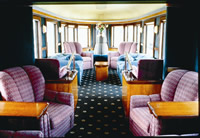 |
Observation car.
Photo: courtesy of AOE |
Hearing about, seeing and experiencing these superlatives makes the journey all the more incredible. The AOE whisks us from park to park via refurbished luxury cars that speak to the golden era of rail travel and the great adventures to be had out West.
Yes, travel is unpredictable and we experience a few glitches in mechanics along the way. But getting there is half the fun and, with my new "golden railer" status, I'll be greeting the uninitiated someday soon when I ride the rails to a new adventure.
Before You Go... |
Planning a train trip is unlike planning for any other type of vacation. While it's an incredible experience and one that shouldn't be missed, there are several things to take into consideration while preparing for your travels.
1. Pack Lightly. American Orient Express suggests one medium-sized checked bag (10x16x24) and one carry-on per person. Soft-sided luggage is easier to store. There is no storage area outside of your cabin, so things need to be stowed in a space below the lower sleeping berth, overhead and in one small set of drawers. Pack comfortable clothes that travel well and are relatively wrinkle-free. Some passengers like to dress-up for dinner, but it's certainly not a requirement. Comfortable walking shoes and closed-toe shoes for when on the train are a must. Toiletries, such as shampoo, conditioner, soap and moisturizer, are stocked in each cabin at the beginning of the trip.
2. Who Should Go. The train cars were refurbished before the American Disabilities Act and therefore do not comply with ADA standards. The train cars cannot accommodate wheelchairs or most walkers. If a passenger can manage on the train without these, but will require some assistance when off the train, they must provide their own collapsible wheelchair or walker and have a companion who can assist them. In addition, children ages eight and older are allowed on board the train, but children under the age of 16 must be accompanied by an adult on the train and during all tours. No pets are allowed and there is no smoking anywhere on the train except in the vestibules between cars.
3. Miscellaneous Expenses. The following expenses are not included in the price of a trip: airfare and taxes; transportation to and from the airport; travel insurance; laundry, telephone, fax, or taxi charges; liquor (with the exception of house wines during dinner and cocktails at the welcome and farewell cocktail hours onboard);, and gratuities for the train staff.
4. Dining Onboard. Meals are served in two dining cars, with open seating and flexible times as stated in the daily itineraries. Request any special dietary needs either when booking the trip or in the forms supplied for documentation.
5. Cabin Comfort. Many passengers comment on the small size of cabins, which, we're told, are "comfortable but compact." Even the deluxe and presidential suites are on the small side, although these have private showers. All other cabins have only a toilet and a basin, with showers at the end of the car (shower time reserved through the porter on the first day). |
AMERICAN ORIENT EXPRESS NOW
OFFERING ONLINE BOOKING
Travelers interested in a deluxe trip onboard America's premier, private train, American Orient Express (AOE), can now book their rail vacations with ease, online at GrandLuxe Rail Journeys
By visiting the AOE website, passengers are able to plan their trip from start to finish. New online booking gives customers the ability to select itineraries and travel dates, as well as to view and choose cabin categories with a click of a mouse. | |