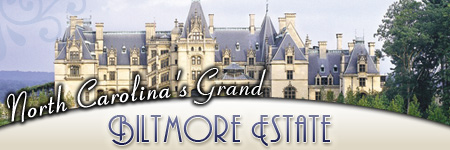
Bask in the Majesty of North Carolina's Biltmore Estate
by Denise
McCluggage
Always
curious about how the other one half of one percent lives,
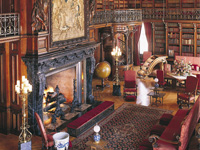
I like touring stately homes, imagining I'm a guest reading
by that crackling fire in a cozy library no larger than
my entire house, or waking in a tester bed in a room far
down a hallway lined with ancestors posed with croquet mallets
or tiny dogs with frilly ears. In my scenarios I'm the one
to pull the tapestry rope to bring aproned servants to my
beck, not the one that arrives apace from below stairs,
but in actual fact I often find below stairs the most fascinating
part of these grand residences of another era.
 |
My favorite such home is special for a number of reasons:
it is the largest private residence in the country; it still
contains most of its original furnishings, not replicas; it
is still privately owned by descendants of the family that
built it; and it plays most directly into my fantasy of being
a guest rather than a tourist. I speak of the Biltmore Estate
in Asheville, N.C., formally opened on Christmas Eve, 1895.
The 250-room mansion filled with art and curios from world
travels was built by George Washington Vanderbilt III,
the grandchild of Cornelius Vanderbilt, the "Commodore."
His great grandson, William A.V. Cecil jr. is the CEO of the
Biltmore Company.
That sense of being a guest instead of a gawking tourist is
not unique to me; on a recent visit I heard the same sentiment
expressed by others over afternoon tea at the Inn on Biltmore
Estate, a 213-room four-star hostelry that seems much more
settled in than its 2001 opening would imply. It is, so far,
the only lodging actually on the 8000-acre estate.
The welcoming aura is fostered by a relaxed atmosphere and
a thoughtful marshalling of traffic so that one never feels
regimented or herded even on the busiest days. Well, there
is that $40 daily ticket, but think of it as a hostess gift.
Then drive through the magnificently designed grounds which
are exactly what Mother Nature would have created had she
the talents and taste and budget of Frederick Law Olmsted,
a landscape architect perhaps even better known for New York's
Central Park.
And mark this: the tours through the Biltmore House can be
self-guided so you can dawdle in the billiard room, the music
room, the tapestry gallery, the fascinating basement.
The Biltmore is old but it is not frozen in time. It continues
to evolve. In 1985 the vineyards resulted in a prize-winning
winery. (And delightful Bistro) New rooms are refurbished
in Biltmore House. Indeed the fourth floor was opened in July
of 2005 with three maid's bedrooms and the servants' hall.
And appearing are new restaurants with a settled feel, new
shops organically conceived. All suited to the overriding
plan true to the original Biltmore philosophy. Harmony is
well served. That's why there are no tennis courts or golf
courses on the property though devotees of those pursuits
are well-served nearby.
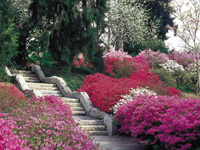 |
The
expansive gardens, formal and informal, celebrate each season
with an orchestra of color. Into azaleas? There's 20-acres
of 'em. Rhododendrons, because this is North Carolina. Dogwood
glowing in brown-limbed woods. And every country represented
by specific topiary.
Walk, ride horses, mountain bike on inviting paths that
curl through the woods beside reflecting ponds. And now
partake of a Land Rover Experience on special off-road routes
through tangles of woods and leaf-paved tracks.
Fly-fishing, float trips, carriage rides. Jazz, blues and
chamber music. Anything that thoughtful, imaginative hosts
might think up to entertain guests. That's us. Demonstrations,
too, of how things were done in the old days. Educational
without your noticing.
My thought: the Biltmore Estate is an ideal and unique family
destination with the reality of present and past combining
in lasting substance rather than the ephemeral froth of
cartoon parks. The Biltmore is a hardbound book for the
shelf, not a paperback to be left behind on the plane.
And think: it's only the swerving of chance that G.W. Vanderbilt
isn't your great-grandfather. So drop by for a family visit;
you'll be welcomed. Now and on your return.
Read more about the Biltmore by Jessica Howell.
If
You Go: |
THE
BILTMORE ESTATE
1 Approach Road
Asheville, N.C. 28803
For Reservations Call 1-800-624-1575
www.biltmore.com
Biltmore Estate is open 365 days a
year.
Admission Gate and Reception & Ticket Hours:
January - March 14: 9:00 a.m. - 4:00 p.m. ET
March 15 - December: 8:30 a.m. - 5:00 p.m. ET | |