| Mercedes
Brings Back a Fuel Saver Just When the Need is Greatest. |
2005 Mercedes-Benz E210 CDI Review
Those
dirty, smelly, black belching, clattering things known as the diesel engines may
be the power plant of your future.
Fret
not. The diesel no longer needs to be dirty, smelly, black belching or clattering.
That negative image is so 20th Century. A
new era has dawned for diesel. German car makers especially are striving to erase
from American memory that outdated view of diesel's drawbacks. This at a time
when diesel's strengths like longevity and superior fuel economy are particularly
relevant. The
North American side of the Atlantic is far behind Europe in embracing the diesel.
Some 40-45% of all continental cars are diesel while in the US market penetration
is still in single digits. Fuel in Europe costs two to three times the peak US
prices making the news lately. Economy is serious business in Europe and diesel
at its worst is 25% more economical than gasoline at its best. 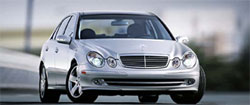
Besides being stars
of the miles-per-gallon sweepstakes diesels are low maintenance (service this
new M-B every 30,000 miles and its likely to be good for 300,000.) Since 1936
when Mercedes put the first diesel engine into an automobile some half-million
diesel cars have found U.S. garage space. Half of them, MB says, are still on
the road, still driven by dogged diesel partisans. Those
loyalists who just might crave a more sybaritic setting for their admiration of
the diesel can now rejoice. After a five-year absence of the "D" in
a sedan for the US it has returned in the 2005 Mercedes-Benz E320 CDI. Outwardly
the diesel E-Class is indistinguishable from the gasoline-powered version, but
will cost about $1000 more (starting at just under $50,000.) That premium may
well be paid back before the year is out through fewer stops for refills at the
pump. The
"CDI" designation in this E-Class encodes breakthrough innovations in
diesel technology. The letters stand for "common-rail direct injection"
which in this 3.2 in-line-six serves to transport the inherent efficiency of diesels
into even greater efficiency. The fuel metering system manages to deliver to the
engine (in concert with the Variable Nozzle Turbine or VNT turbocharger) the optimum
amount of fuel needed for the task of the moment and is laboratory precise. Thus
the new quiet, the new smokelessness, the smart takeoff from a stop and the mileage
rating upwards of 30 mpg in mixed city and highway. Comparing
the diesel E to the gasoline-powered E: both have a five-speed automatic transmission.
The diesel produces 201 HP, the gas engine 240. But the diesel delivers 369 foot-pounds
of torque in the 1800-2600 RPM segment of the tachometer. The higher-horsepower
gas version is rated at 232 ft-lb of torque at a higher point on the tach.
For those bemused
by horsepower and torque it comes to this: torque is more important to American
driving, particularly at the place on the power curve where this diesel plays
hardball. Loads of low-end torque means that wonderful leap off the line at an
intersection and reassuring readiness for quick highway passes. More horsepower
will get you higher speeds on the Autobahn, but Americans cannot legally cruise
in the three-digit mph range. And FYI, the diesel takes 6.8 seconds to reach 60
mph; the V6 gas E-Class takes 7.1.
As
much as techno hearts may flutter over the "common-rail direct injection"
(love saying that) of this diesel engine the proof of any vehicle is in how it
looks, performs and makes the driver feel.
I
can safely report based on my recent experience of the car in the San Antonio
area that the new diesel can flutter hearts on those counts as well. Indeed, I
cannot conceive of anyone preferring the gasoline version to the diesel.
This
E-Class has the enduring presence we expect of Mercedes but it's a more Schwabian
who regularly vacations in Italy. Amidst the solidness and comfort there's a penchant
for pleasure, a lightness of spirit and out and out cavorting on roads that dart
and twist. It feels right fine; and it left this driver feeling sporty and smiling
quite a bit.
As
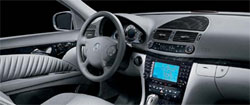
for some negatives: the cabin, please note if it matters to you, allows the intrusion
of more road and tire noise than say a Lexus. I personally don't mind the sounds
of the driving environment, particularly when I'm having fun. My colleagues griped
a bit about the many layers of the COMAND system with its central screen for controlling
navigation information, heating and cooling, the in-car phone and the sound system.
However I prefer the sounds of driving (see above) to music or talking when I'm
busy at the wheel so you'll have to judge the COMAND system for yourself. Suffice
to say it is not as annoying as the BMW iDrive, which is praising with faint damns.
At the San Antonio
press introduction of the E-Class CDI we were treated, if that's the word, to
an economy run from the lunch venue in the Hill Country back to our hotel on the
Riverwalk. Prizes were to be awarded. My driving partner and I decided we didn't
want to go through the ritual of those intent on saving fuel by the droplet, stuff
like turning off the A/C, putting more air in the tires, coasting down hills and
riding in the slipstream of 18-wheelers. Indeed, we did not want to alter our
habits in any way. Said I: "Let's just drive as we normally would with a
bias toward getting there quickly; you can buy fuel but you can't buy time."
So
we weren't in the spirit of the competition, but we got back to the hotel first.
And no surprise, we ranked last in the contest. The winners posted an astonishing
47 miles to the gallon. But get this: we, the "losers," got 30 miles
to the gallon. Is that losing? This in a no-compromises roomy sedan at speed getting
an easy 30 mpg. Love that diesel.
Mercedes
plans to make only 3,000 of the CDIs available this year. It's
my belief that those will last as long as a snowball in July
so trot to your dealer instantly. But there is a rub. Even a
diesel engine this clean is not sold in California, New York,
Massachusetts, Maine or Vermont.
For
More Information Click: Mercedes
Benz E320
For the Mercedes-Benz 2005 Model Guide : Click
Here
|