|
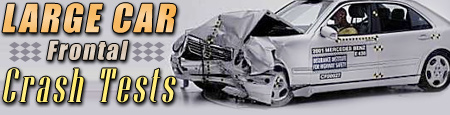
Frontal Crash Test Results for Large Cars
A group of five large family
cars and three large luxury cars earned top ratings of good
in frontal crash tests recently conducted by the Insurance
Institute for Highway Safety. Among the family models that
were tested - Buick LaCrosse, Chrysler 300, Ford Five Hundred,
Kia Amanti, and Toyota Avalon - all but the Amanti earned
the added designation of "best pick" in the frontal
test (see attached ratings). This is the first time every
model in a group of large family cars has earned the top
rating.
The
large luxury cars - Acura RL, Cadillac STS, and Lexus GS
- also earned good ratings, and each is designated "best
pick" for frontal crash protection.
"Large
cars are a good choice for consumers looking for a safe
family vehicle, but some of them haven't always performed
well in the Institute's frontal crash test," says Institute
chief operating officer Adrian Lund. "In 1999 a large
family model from DaimlerChrysler, the Chrysler LHS, along
with its twin 300M, was rated poor for frontal crash protection.
With these latest results we now have 10 current large family
car designs that are rated good."
The
ratings reflect performance in a 40 mph frontal offset crash
test into a deformable barrier. Based on the results, the
Institute evaluates the crashworthiness of passenger vehicles,
assigning each vehicle a rating from good to poor. The better
performers among those rated good earn the added designation
of "best pick." If a vehicle earns a good rating,
it means in a real-world crash of similar severity a belted
driver most likely would be able to walk away with nothing
more than minor injuries. About half of all vehicle occupant
deaths occur in frontal crashes.
Chrysler
300 has big improvement compared with its predecessors:
"The 2005 model year 300 is a good performer across
the board in the frontal test. This is the kind of performance
we like to see," Lund says.
The
Institute's offset test is especially demanding of a vehicle's
structure. The driver side of a vehicle being tested hits
the barrier, so a relatively small area of the front-end
structure must manage the energy of the crash. The structure
of the 300's occupant compartment maintained its shape very
well, and that allowed the seat belt and airbag to do a
good job of protecting the driver. After the dummy moved
forward into the airbag, it rebounded into the seat without
its head coming close to any stiff structure that could
cause injury.
"The
occupant compartment in the LHS/300M buckled during the
crash, and there was major intrusion into the footwell area,"
Lund explains. "The airbag deployed so late in the
crash that the dummy's head hit the steering wheel hard."
Chrysler made changes to the 2001 model, and its crashworthiness
rating improved to acceptable. There was less intrusion
into the occupant compartment, and the airbag did a good
job of keeping forces on the dummy's head low.

|
 |
2005
Chrysler 300
Structure: GOOD |
1999
Chrysler LHS/300M
Structure: MARGINAL |
"Now
the 2005 model Chrysler 300 and its twin, the 2006 Dodge
Charger, are among the top performing large cars in the
Institute's frontal test," Lund adds.
The
Five Hundred is latest among Ford's good performing large
cars: The 1995 Taurus was one of the first vehicles to earn
"best pick" in the frontal test. It was redesigned
in 1996 and re-engineered in 2000. Both of these models
also were good and earned "best pick" status.
"Ford
should be commended for leading the way in frontal crash
protection in large family cars," Lund says.
Three
large luxury cars are rated good: Every current large luxury
car model rated by the Institute is good in the frontal
offset test. All but the Lincoln Town Car earned "best
pick".
In
the current round of tests, the Cadillac STS is another
example of how the crashworthiness of cars has been improved.
The STS's immediate predecessor, the 2000 Seville, also
earned a good rating in the frontal test. However, the previous
generation model didn't fare as well. The 1997 Seville was
rated poor, mainly because its structure allowed too much
intrusion in the occupant compartment, including major rearward
movement of the instrument panel.
Summary
of results for all large
family cars and large
luxury cars tested by the Institute
(Source: IIHS) |