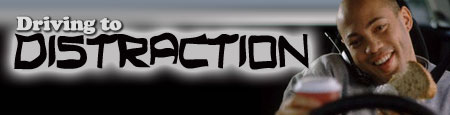
How to Keep Yourself From Driving Distracted
Each
year in the United States, there are more than 16 million
motor vehicle crashes. The National Highway Traffic Safety
Administration (NHTSA) estimates that 20 to 30 percent of
those crashes involve driver distraction.
"Whether
it's because of work or pleasure, our vehicles have almost
become second homes," said Jeff Blum, director, PPG
Industries Automotive Aftermarket Alliance, which includes
the CertifiedFirst™ Network of more than 1,500 professional
auto body repair centers across North America. "That
means that more and more drivers are doing things in the
car that they might normally do in their homes, including
eating, grooming, and talking on the phone. The auto body
repair centers in our network, both dealership or independently
owned, see vehicles on a daily basis that are damaged in
crashes as a result of distracted drivers."
|
"There
are a lot of distractions both outside and inside
a vehicle, Despite their best efforts, even the most
careful and attentive drivers can become involved
in an accident." |
While
cell phones are usually targeted as the prime culprit of
distracted driving, studies by NHTSA show that there are
a number of things driving motorists to distraction. Personal
grooming-combing hair, applying makeup, adjusting contact
lenses-eating or drinking, changing the radio or CD player,
and even children riding in a vehicle are also distractions
that can lead drivers to an accident. But because cell phones
impose a mental distraction as well as the physical distraction,
they have a particularly bad image as a driving hazard.
There
are more than 140 million cell phone users in the U. S.
alone. According to a government survey, about three percent
of those are on the road at any given time. That's 4.2 million
drivers talking on the phone every day. Now that phones
are becoming increasingly complex, with the incorporation
of wireless Internet connections, cameras, and text messaging,
the hazard of talking of the phone while driving is on the
rise.
New
York is the only U.S. state that currently has a ban on
cell phone use while driving. Ten states, Arkansas, Arizona,
Connecticut, Maine, Massachusetts, New Hampshire, New Jersey,
Ohio, Pennsylvania, and Tennessee, have enacted legislation
that partially bans cell phone use while driving. Partial-ban
legislation includes bans for school bus drivers, minors,
and those with provisional or learners' driving licenses
as well as allowing individual municipalities to set their
own restrictions. Massachusetts law says that drivers must
keep at least one hand on the steering wheel while holding
a phone.
Even with the high visibility of "the cell phone factor," 18 to 28 percent of crashes where driver distraction was a factor involved other distractions. New telematics, or electronic devices like televisions, DVD players and navigation systems, often come standard on many new vehicles and are in great demand, but can also create distractions for drivers.
"There are a lot of distractions both outside and inside a vehicle," said Blum. "Despite their best efforts, even the most careful and attentive drivers can become involved in an accident."
If you're ever in an accident, here's a list of 11 easy steps to remember as compiled by the National Safety Council:
-
Stop your vehicle if it is clear, safe and legal.
-
Move the vehicle out of the traveled roadway, if it is clear, safe and legal. (In some states it is against the law to move the vehicle from the place where the accident occurred. Check the ordinance in your area.)
-
Turn off the ignitions of the cars involved.
-
Make a first aid check of all persons involved in the accident.
-
Call the police and, if necessary, emergency medical services.
-
Mark the scene of the accident with flares or retroreflective triangles.
-
Gather the names* of all persons in the motor vehicles and people who witnessed the accident.
-
Make a quick diagram of where the vehicle occupants were seated and indicate the vehicles' direction of travel and lane. Also note the date, time and weather conditions.
-
Ask to see the other driver's license* and write down the number.
-
Exchange insurance company information. DO NOT discuss "fault" or make statements about the accident to anyone but the police.
-
Get a copy of the police report of the accident from the local precinc
Visit www.certifiedfirst.com and go to the "What To Do In Case of an Accident" section. There you'll find advice on being prepared, including a helpful, downloadable "Accident Report Form" that can be kept in the glove compartment. You can also find the nearest CertifiedFirst Network collision repair center near you by using the dealer locator. |