Head Rests Can Prevent Whiplash and Other Neck Injuries
by
Cheryl Jensen
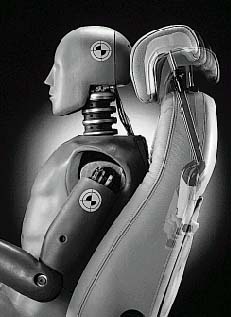 Automobile
head restraints, those things perched on top of the seats that most of us call
“head rests,” became a safety requirement in 1969 to help prevent whiplash
injuries that can occur when the head is thrown backward suddenly, usually in
a rear-end collision.
Automobile
head restraints, those things perched on top of the seats that most of us call
“head rests,” became a safety requirement in 1969 to help prevent whiplash
injuries that can occur when the head is thrown backward suddenly, usually in
a rear-end collision.
Since
then, head restraints have received little attention in spite of the fact that
these neck injuries are the most serious injuries reported in 30 to 40 percent
of automobile insurance claims, according to findings of the Insurance Research
Council, a research group in Wheaton, Ill., that is financed by insurance companies.
While
whiplash sometimes figures in cases of insurance fraud, it’s also a serious
safety issue—particularly for women who are much more likely than men to
get whiplash injuries.
The
symptoms of whiplash can vary, depending on which muscles and nerves are damaged.
They can include neck pain and decreased range of motion, headaches, dizziness,
ringing in the ears, numbness and tingling of the fingers, and hand-grip weakness.
There’s speculation that whiplash injury can trigger and accelerate degenerative
disk disease. In the worst cases, symptoms can become chronic and debilitating.
The
need for safer restraints
Although
head restraints in theory can help prevent these injuries, to do the job they
must be well-designed. Most, however, are not, safety experts say.
Most
restraints either do not lock—which means they can be pushed down by a head
snapping back—or they can’t be raised high enough or moved close enough
to the back of the head to protect the vulnerable neck.
Two
studies done by the Insurance Institute for Highway Safety (IIHS), one in 1995
and the most recent in 1997, found that head restraint designs were generally
deficient in preventing these injuries. The most recent study looked at 200 passenger
vehicles from the 1997 model year, and found that only five had well-designed
systems. Those were the Honda Civic del Sol, the Toyota Supra, the Volvo 850 (which
has been renamed the S70 and V70), the Volvo 960 (now the S90 and V90), and the
Mercedes-Benz E-Class. In addition, 33 vehicles were rated acceptable, 49 were
marginal, and 124 were poor.
Some manufacturers whose vehicles received poor ratings have questioned the validity of the testing. For instance, a spokesman on safety issues for General Motors Corporation said GM developed its head restraints based on performance tests rather than measurement criteria, which are the basis for the IIHS’ ratings.
The Institute, a lobbying and research group funded by the insurance industry, located in Arlington, Va., uses two measurement criteria to determine whether head restraints are well-designed. Ideally, the top of the head restraint should be at least as high as the top of an occupant’s head, or at least as high as the head’s center of gravity, which is about 3.5 inches below the top of the head. Also, the gap between the back of the head and the front of the restraint should be no more than four inches.
Fixed head restraints, which are part of so-called high-back seats, are generally better than adjustable restraints because they’re already set at the highest point. Adjustable restraints, on the other hand, must be raised and lowered by the car’s occupants and most people don’t bother.
Brian O’Neill, IIHS president, said, however, that many fixed head restraints still aren’t high enough or close enough to the back of the head to provide adequate protection. When the latest study was released, O’Neill called the results “a sad showing.” A year later, there seems to be room for a little more optimism as more automakers pay more attention to saving motorists’ necks.
“Things never happen as fast as we’d like them to happen, but things are happening,” O’Neill said.
The National Highway Transportation Safety Administration (NHTSA) is considering upgrading U.S. standards (which say head restraints must be 27.5 inches higher, when extended, than a point near the intersection of the seat cushions) to match European standards (which currently require them to be 29.5 inches high and are to increase to 31.5 inches next year), partly as a result of a movement to “harmonize” safety standards. The idea of harmonizing is to have one universal standard that would protect all consumers with the best safety practices while simplifying the design of vehicles sold worldwide.
“It’s a global industry now, and there’s much more interest in whiplash and prevention in Europe now than in the U.S.,” said O’Neill. “There’s a growing awareness over there that this a real problem, not just an insurance fraud problem.”
Making Safer Restraints
The problem of whiplash is serious enough in the eyes of some automakers that their safety researchers and engineers, as well as their seat suppliers, have developed innovative ways to reduce these injuries.
Late last year, Saab became the first automaker to introduce an active head-restraint system as standard equipment for front seat passengers in its new 9-5. The 9-5, which debuted in the United States this spring, is the 1999-model year replacement for the 9000 model. Saab has now made that system standard equipment in its new 9-3, the replacement for its 900 model.
The Saab Active Head Restraint system (SAHR), developed with General Motors Corp. and Delphi Interior and Lighting Systems, operates using simple mechanical principles. The head restraint is connected to a pressure plate in the seatback. In a collision from the rear, the occupant is pressed into the seat back which moves the pressure plate to the rear. That pressure triggers a rocker arm lever that forces the head restraint upward and forward, in effect “catching” the head before it can jerk backward. In most cases, this system will not require repair after a crash, unlike pyrotechnic systems such as airbags. After the head restraint has been activated to limit the head’s movement, it reverts to its original position.
Volvo has announced that the 1999 S80, its new, large-platform, four-door sedan, will come equipped with front seats designed to substantially reduce whiplash injuries in low-speed (under 20 mph), rear-end collisions. This vehicle is currently scheduled to be in dealerships in October.
Volvo’s system bears the acronym it had as a research project: WHIPS (Whiplash Protection Study). In a rear-end collision, when the occupant is thrown back against the seat and the head restraint, the system is activated. The back of the seat and the head restraint move backward with the occupant, reducing the interior movements in the spine.
This system allows the occupant’s entire upper body and head to be caught in what Volvo engineers describe as a balanced, gentle manner while much of the crash energy is absorbed. The system helps ensure that the head remains close to the head restraint. Then the seat back tips backward, helping absorb the remaining energy and reducing the forward rebound that the body experiences in a standard seat. Researchers believe this rebounding effect is a major contributing factor in whiplash injuries.
Women face a greater risk
Women have “twice the risk of these injuries,” said Dr. David Viano, principal research scientist at the GM Research and Development Center in Michigan, and one of the researchers who worked on Saab’s head restraint system.
There may be several reasons why, say Viano and Kristina Wiklund, a safety development engineer at Saab AB’s Technical Development Center in Trollhattan, Sweden.
“Women generally have more slender necks than men and smaller muscles in the upper body, said Wiklund. These factors make women more vulnerable to the whipping motion.
“Women drive in situations that expose them more to rear-end collisions,” said Viano. Women tend to do more stop-and-go driving in downtown environments than men, who tend to do more of the long-distance interstate highway driving.
“Another contributing factor may be that women tend to sit more upright in the seat than men, increasing the gap between the head and head restraint,” said Wiklund.
More signs of progress
In addition to Saab’s and Volvo’s advanced designs, other manufacturers are making changes based on the IIHS’ evaluations. Volkswagen, for example, is changing the head restraints on its New Beetle to get a better score. The original head restraint design was rated “acceptable” by the Institute. That evaluation was based on a scale graded “good,” “acceptable,” “marginal,” and “poor.”
When Volkswagen learned of the rating, it responded quickly. “It was decided if we made the small change we could get an even better mark,” said a Volkswagen spokesperson.
Consequently, Volkswagen is making the stalks that hold the head restraints taller, making it impossible to push them all the way down. This change will be a mid-year adjustment starting with June production. With this new design, the head restraints fit more people and start in a safer position.
Some manufacturers, including Audi, are adding locking mechanisms on head restraints that secure them at the intended height to prevent the restraint from being pushed down when the occupant’s head hits it in a crash. Others, Chrysler, for example, are making the head restraints on some models that exceed the U.S. and European standards. A Chrysler spokesperson said that the head restraints on the 1999 LHS and 300M (which will be sold in both the U.S. and Europe) reach 32 inches.
What you can do
While this issue is finally getting the attention it deserves, it may take time until newer systems are more widely available. Until that happens, you can take steps to protect your own neck. First, start thinking of head restraints as a safety requirement. When buying your next vehicle, see how the head restraints fit for size and whether any of these new systems are being used. If the vehicle you’re shopping has adjustable head restraints, check three things. Do they lock in place? Can they be raised high enough to reach nearly to the top of the head—whatever the height of the driver or passenger? Can they be articulated (rotated forward) so that they’re close enough to the back of the head?
And whenever you get into a car, the most important thing you can do is adjust the adjustable head restraint. “One of the problems we deal with is that the adjustable restraints are almost always left in the down position,” said O’Neill. “They need to be up behind the back of the head and as close as is comfortable.”
Information about head restraint systems is available through the IIHS. Although the Institute evaluated 1997 models, O’Neill says that most of the information is still current and it is updated whenever a design change takes place. Evaluations are available for free by sending a postcard or note (no self-addressed, stamped return envelope is needed) to Insurance Institute for Highway Safety, Attention: Head Restraints, P.O. Box 1420, Arlington, VA 22210-1420. As the Institute conducts crashworthiness evaluations on newer models, it also evaluates head restraint systems. You can write to the same address and ask whether the vehicle you are considering has been evaluated. The information is also available on the Internet at http://highwaysafety.org.