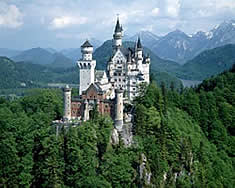
 | | Neuschwanstein
Castle, the world-famous "fairytale castle" of the Bavarian King Ludwig
II was built between 1869 and 1886 in neo-Romanesque style and in imitation of
a medieval German knight's castle. The interior rooms are ornately decorated with
scenes depicting the medieval world of saga and legend. |
The
landscape of Bavaria unfolds as fairytales do, over towering mountains and emerald
green lakes; through twisting paths under heavily treed forests; within medieval
castles where horse-drawn carriages carried kings and queens and the echo of hooves
resonates still. Amidst the camaraderie of family and friends, the story continues,
over a hearty meal and a stein of beer, 'round well-worn tables at much loved
beer halls and beer gardens.
Listen
to a soaring Wagner opera or the rousing oom-pa-pa of a local band; sample white
sausage (eaten only before noon) or linger over afternoon kaffee und kuchen;
breathe clean alpine air and the welcoming scent of freshly baked bread, and you'll
begin to experience the magic of Bavaria.
Start
your journey in Munich, the capital city of Bavaria, before traveling south to
the mountains. Whether dressed in the traditional lederhosen and dirndl or contemporary
fashions, locals wear a welcoming smile, and will be happy to tell of the region's
storied past and share their love for all things Bavarian. If
you do nothing else in Munich, walk the streets of the old city, some of it actually
rather new but built to look as it did before WWII. It was by a narrow majority
vote that the damaged parts of the city were rebuilt with a nod to the past rather
than as a modern metropolis. One walk through the Marienplatz with its musical
Glockenspiel and you'll be glad the city is as it once was. Stroll down Maximilianstrasse
past the windows of exclusive shops, and through a gracefully landscaped Englischer
Garten.
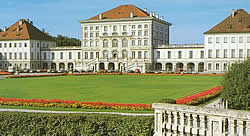 | | The
Castle Garden of Nymphenburg Palace was greatly enlarged in the eighteenth century
and was laid out in the French style (using Versailles as a model) by from 1715
onward. In the nineteenth century, the garden was remodeled according to the tenets
of English landscaping while retaining the main elements of the Baroque garden. |
Nymphenburg
Palace also has its garden, and tells of one monarchy that lasted through most
of Bavaria's history. Of the 32 Bavarian palaces and royal residences and 13 castles
and fortresses, several belong to the illustrious King Ludwig II who was born
at this palace in 1845. Another
walk through the bustling Viktualienmarkt and your senses will be embraced by
the city. Fuel up on regional edible treats, or simply soak up the local flavor.
Of course, you can burn off all indulgences on countless places to walk and bike
in Munich. Just a short drive or train ride from the Alps, Munich is home to many
outdoor enthusiasts. You're not likely to find many Bavarians inside on warm,
sunny days.
Alternatives
to the outdoors include museums such as the impressive Deutsches Museum (of science
and technology) and the Bayerisches Nationalmuseum (Bavarian National Museum),
or a performance by the world-famous Bavarian State Opera, among countless other
music and theater options. Once you've covered Munich, several gems nestled within
the Alps await your arrival. All are an easy drive from Munich, or are a quick
train ride from Munich's Hauptbahnhof Station.
Schwangau
Visit
what many consider the most famous of the Bavarian castles - Neuschwanstein Castle
- built under the impetus of King Ludwig II, the "dreamer king" who
had many castles built but only one ever finished. Then stop by Hohenschwangau
Castle, where Ludwig II grew up, within view of the location of his future masterpiece
castle. The Kind Ludwig Musical on Furggensee Lake tells the sad tale of this
king who appreciated all things beautiful.
Berchtesgaden
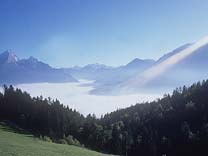 |
| The
Berchtesgaden National Park is one of the oldest protected areas in the Alps. |
Outside
this town is one of two national parks in Bavaria; the stunning landscape a nature
lover's dream and a playground for sports enthusiasts. Take a smooth and silent
electric-powered boat ride across Königssee lake or hike along park trails,
paraglide from soaring alpine peaks, or raft a churning river.
Murnau
Art
enthusiasts will love the picturesque streets of Murnau perhaps finding from the
surrounding landscape as much inspiration as the famous painters who lived here.
View the works of Gabriele Münter and Wassily Kandinsky at the Schloss Museum
and the visit the Münter Haus where they lived and painted much of their
work. Browse through several local galleries, and purchase one of the unique paintings
on glass from a local painter.
Garmisch-Partenkirchen
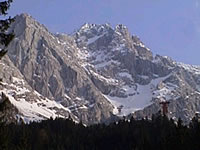 |
| At
the peak of the Zugspitze, you'll find Germany's highest restaurant, the "Gipfelstube."
Bavarian specialities are served, such as fresh pretzels with Weißwurst
sausage or Leberkäse (baked meat loaf made with minced meat, eggs and spices). |
These
two towns make up one of the top alpine resort areas - a great base from which
to explore the surrounding mountains, including the highest mountain in Germany,
the Zugspitze. Travel by cog railway or cable car up to the panoramic viewing
area and a restaurant where you can dine with an inspiring view.
For
more information on Bavaria and on these and other destinations in the Alps, contact
the German National Tourist Board at 212-661-7200 or visit their websites at www.visits-to-germany.com or www.germany-tourism.de.
|