
Enjoy the Soothing Sights in the Turks & Caicos
by
Suzanne Carmel
 |
|
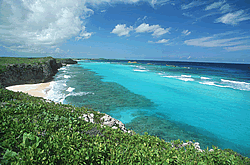
The
coastline around Middle Caicos is
a little more dramatic than that
of the other islands. |
The
debate over who discovered the Turks &
Caicos Islands first - Christopher Columbus
or Juan Ponce de Leon - is still in question,
however it's an indisputable fact that
many people are discovering the islands
today. With an average of 350 days of
sunshine annually, a constant breeze and
mild temperatures between 80 and 90 degrees,
the islands are the perfect place to break
away from the daily routine - and not
just in winter.
The
islands are a study in contrasts. Here
one can find the ultimate in luxury resorts,
or bare bones beachside shacks; the bustling
development on Providenciales or the slow
and easy pace of life on more remote islands
such as Salt Cay. Though the islands'
capital and head of government and commerce
is on Grand Turk, it is far less developed
that Providenciales, where many tourists
take their vacations.
Grand
Turk and Salt Cay - two of the islands
in the Turks group - are famous spots
for diving. The 260 mile-long coral reef
system here offers some of the best diving
in the world. Interestingly enough, the
islands are also known by avid stamp collectors
for producing new series of high quality,
well-designed stamps on a regular basis.
There aren't many nations that can boast
two such disparate claims to fame!
For
those who are still among the uninitiated,
the Turks & Caicos Islands are a British
Crown Colony of over 40 islands and cays,
located halfway between Miami and Puerto
Rico. The two main groups of islands are
separated by the Columbus passage. Of
the islands, only eight are inhabited.
Grand Turk and Salt Cay on the Turk side;
and Providenciales (frequently called
Provo), North Caicos, Middle Caicos, South
Caicos, and the private islands of Parrot
Cay and Pine Cay on the Caicos side.
The
main islands cover about 193 square miles
of land, 230 miles of which are white
sandy beaches along the coastlines. There
are only about 24,000 local inhabitants,
comprised primarily of the descendants
of former slaves brought here to work
on plantations, and of expatriates primarily
from Great Britain and anywhere else someone
heard the call of this natural paradise.
Even
with a burgeoning industry in tourism,
the government keeps a watchful eye on
development. You won't see any buildings
on Provo above four stories; on all other
islands, two stories. Buildings must allow
for public access to the beaches beyond
them, all of which are public. A portion
of the land and marine environment is
comprised of 33 national parks totaling
272 square miles. On Provo, most of the
hotel development is along Grace Bay which
is actually part of a national park. In
these parks, there are restrictions on
water sports activities, and the environment
is checked and monitored by the government
department of environment and coastal
resources and the national parks department.
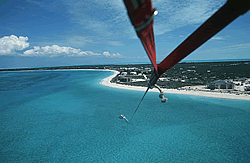 |
Parasailing
from Provo |
This
emphasis on protecting the natural environment
ensures that visitors and locals will
be able to enjoy the beauty of these islands
and the local flora and fauna for many
years. In addition to spectacular diving
and snorkeling, there are many ways to
enjoy these islands. Choose from deep
sea, bone and bottom fishing; watching
for humpback whales between January and
April, sunset and glow worm cruises; bird
watching; land activities such as hiking,
biking, horseback riding, golf and tennis;
water activities such as sailing, parasailing
and wind surfing, and assorted day trips
or excursions to the other islands.
Little
Water Cay, not far from Provo, is a great
stop along the way to some of the other
islands. Stroll along the boardwalk here
and you'll likely encounter some of the
2,000 rock iguanas that call this island
home. There are 50,000 of this endangered
species living on the islands. Many have
been relocated to preserves such as this
one in order to protect them. A day boat
trip from Grand Turk to Gibbs Cay affords
visitors a chance to meet another of the
local residents. Slip into the water after
donning mask and fins and friendly stingrays
will swim up to greet you. Even from the
deserted beach it is possible to see these
graceful creatures gliding along the shallow
water along the shore.
For
those who prefer to admire the water from
above, a boat cruise from Provo affords
the perfect way to view the islands from
offshore. Sunsets in the Turks & Caicos
Islands can be pretty spectacular even
if you don't get a chance to see the much
touted "green flash" that occurs
on clear days as the sun dips into the
horizon. Out on the water, as darkness
descends on the landscape the sky is blanketed
by stars. For a few days once a month,
typically five to six nights after a full
moon, the stars are mirrored below the
surface of the water as well. Tiny glow
worms swim to the surface to mate, giving
off neon light. Though brief, the ritual
is well worth the boat trip.
It's
another short trip by boat from Provo to North
Caicos for an eco-adventure tour. Scooters or
bikes make it easy to see local attractions such
as freshwater Cottage Pond, the ruins of Wade's
Plantation and the shy, colorful birds that frequent
Flamingo Pond. These tours allow visitors to meet
locals, and to experience lunch in a resident's
home. Another trip from Provo, this time by air,
will get you out to Grand Turk where you can visit
the national museum and learn about the history
and culture of these islands. From either here
or Salt Cay you can also go whale watching during
season, snorkel and dive. Grand Turk and Salt
Cay offer less populated places to vacation, with
73 and 45 hotel rooms respectively.
No
matter where you are in the islands, you'll want
to sample local seafood including conch - endangered
elsewhere, but carefully farmed here. Provo is
home to the world's only conch farm where you
can watch how these creatures develop and see
what adult conch looks like when it pokes out
of its shell. Restaurants on the islands range
from simple grills to white tablecloth fine dining.
Whether it's fried fish with peas and rice or
haute Caribbean cuisine fused with European or
Asian flare, dining is an event in the Turks &
Caicos Islands.
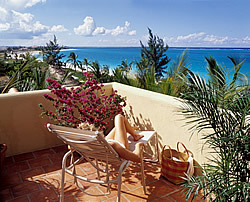 |
Beach
view from the Grace Bay Club |
During
your days and nights here, it will be
easy to see why many people are beginning
to vacation in the Turks & Caicos
Islands. Even though you didn't get here
first, the exciting discoveries you'll
make while on these islands will have
you believing you did.
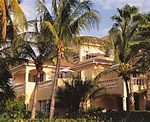 |
Grace
Bay Club |
For
more information on the Turks & Caicos
Islands, contact the tourist office at
(800) 241-0824 in the U.S., (866) 413-8875
in Canada, +44 (0) 208 350 1017 in Europe
or (649) 946-2321/2322 or while in the
islands. You can also visit the website
at www.turksandcaicostourism.com or email the tourist office at tci.tourism@tciway.tc.
There
are many wonderful places to stay among
the islands; many of these places are
listed on the tourist office website.
Two upscale, all-suite hotels on Provo
that deserve a closer look are the esteemed
Grace Bay Club, (800) 946-5757 or www.gracebayclub.com and the new Turks & Caicos Club, (800)
269-0966 or www.turksandcaicosclub.com.
Both are located on Grace Bay along what
is considered by many as the best beaches
in the Caribbean, if not the world. |