|
There
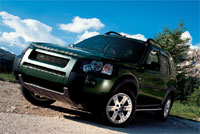
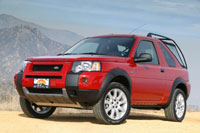
is a fine line between having just enough space, and having
that little bit extra. To solve this dilemma, the Land Rover
Freelander SUV offers two unique sizes, a 5-door SE model and
a 3-door SE3 version. Two sizes, makes the decision of choosing
a Freelander, over its many competitors, that much easier.
Both
models offer excellent interior appointments, reasonable trunk
space and outstanding off-road capability. Seating for five
is standard as well, with a surprising amount of rear seat space
provided in the 3-door SE3. The only choice is whether you prefer
a fixed roof design and four side doors, or two side doors and
the option to remove the rear portion of the roof for true open
aired driving. Either way, the Freelander is sure to impress
with its design and careful attention to detail.
A
potent 2.5L, DOHC V6 engines produces 177 horsepower @ 6,250
rpm and 177 lb-ft of torque at 4,000 rpm. For a medium sized
6-cylinder, the engine supplies strong throttle response and
plenty of power to accelerate onto a busy highway. Torque is
maximized at low rpm, giving it a beefy advantage for off-road
driving.
The
Freelander runs on regular unleaded fuel, placing it ahead of
several of its competitors. With a fuel tank capacity of 16.9
gallons, the baby Rover achieves a maximum range of approximately
355 miles.
A
5-speed automatic transmission provides reasonably smooth shifts,
offering a locking torque converter, Sport/Normal shifting and
manual gear changes.
In
an SUV such as the Freelander, it is critical to offer a suspension
that can multi-task. For this reason, Land Rover graces it with
a fully independent system. MacPherson struts with lower control
arms and long-travel coil springs make up the front suspension,
while in back the lower control arms are replaced with trapezoidal
links.
Long-travel
coil springs are an important reason why the Freelander is such
a great off-road vehicle. Ground clearance is excellent, allowing
it to go where many other, much larger and supposedly tougher
SUV's, wouldn't dare tread.
The
Freelander has permanent all-wheel. It offers further refinement
to the suspension with IRD, (Intermediate Reduction Drive) and
VCU, (Viscous Coupling Unit). Four-wheel traction control is
also standard, making this a hard package to beat.
If
there is a downside to all this technology and ground clearance,
it is only that the Freelander suffers in tight corners, requiring
3.2 turns lock-to-lock. While this may not pose a problem when
negotiating dirt roads off the beaten path, it is an annoyance
while attempting to maneuver in tight parking spaces. Be prepared
to give yourself a little extra space when parking the Freelander.
To
stop the Freelander as quickly as possible, power
assisted front disc brakes and rear drum brakes work
together with all-terrain ABS, EBD, (Electronic Brakeforce
Distribution) and HDC, (Hill Decent Control). Wheel
sizes are 16" on the SE model and 17" on
the SE3.
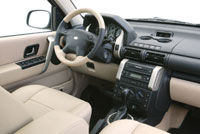
Inside,
the 2005 Freelander offers an almost unparalleled
level of refinement in a vehicle this size and price
range. Cruise control, power windows with one-touch
down driver window and power rear cargo window is
standard. The SE model offers a standard glass sunroof,
while the SE3 offers removable rear panels and a rear
top.
Additionally,
variable speed wipers and a rear wiper/washer are included;
as is tinted glass with both front and rear defrost. Front and
rear foglights add extra safety, as do dual heated rearview
mirrors.
Cupholders
are conveniently placed two in front and two in back. A center
console/storage bin offers plenty of space in a small package.
Both front doors offer map pockets and expandable storage pockets,
while behind each front seat resides an additional storage pocket
capable of holding larger items.
Optional
equipment for the SE model includes perforated leather seats
and a 240-watt Harmon/Kardon 6-disc CD changer with steering
wheel mounted controls, (standard on SE3). Our test vehicle
also came equipped with the optional 18" alloy wheels,
heated front seats, dual illuminated vanity mirrors, side rubstrips
and the always-present Land Rover umbrella.
Exterior
styling was upgraded in 2004, with subtle but important changes
made to the front and rear headlights and fascia on the Freelander.
Not only has this improved the outward appearance, but it is
now easily recognizable as a full-fledged member of the Land
Rover family.
Land
Rover has made significant progress these past few years in
its search for reliability. With looks that emulate the more
expensive Range Rover and newly designed LR3, the Freelander
makes a discriminating choice in the ever popular, small to
mid-size SUV category.
JUST
THE FACTS
| 2005
LAND ROVER FREELANDER |
| Description: |
Mid-size Sport Utility Vehicle |
| Model
options: |
SE3, SE |
| Wheelbase: |
101.0 inches |
| Overall
length: |
174.7- 175.5 inches |
| Engine
size: |
2.5 liter DOHC V6 |
| Transmission: |
Auto/5 |
| Drive: |
Permanent all-wheel |
| Braking: |
Power, ABS/EBD/HDC |
| Air
bags: |
2 (front) |
| Fuel
mileage city/hwy: |
AT:
N/A |
| MSRP: |
$27,495 |
|
For
More Information Click: Land
Rover Freelander
|