|

by
Bob Plunkett
Mercury Mariner goes green with an all-new hybrid model
On Commerce Street, a prime conduit slicing through downtown San Antonio, we're driving at a snail's pace in the far right lane with traffic stacking up behind us.
 |
Our slow-go intent is not to frustrate other motorists along a busy thoroughfare but to figure out exactly how high we might influence the miles-per-gallon fuel consumption numbers along a measured route while steering a new hybrid electric vehicle (HEV) from Mercury.
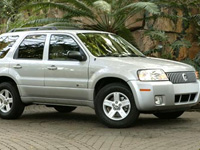
This HEV, looking elegant in a sculptured package with crisp lines and a distinctive prow trimmed in smooth satin-finish aluminum, is derived from Mercury's unibody-based Mariner sport-utility wagon. Its tag is self-explanatory -- Mariner Hybrid.
The HEV looks virtually identical to a conventional Mariner as a four-door SUV for the compact class, save for the addition of a small vent on the left-side C-pillar designed to draw air inside to cool a big battery pack. However, the hybrid powertrain concealed below Mariner's squared front hood is certainly not conventional.
There's a fuel-efficient 2.3-liter four-cylinder engine aboard that drinks gasoline and a battery-powered electric traction motor of permanent-magnet design. The electric motor is capable of propelling the wagon by itself, or it can work in concert with the gasoline engine to deliver a power boost of approximately 155 hp.
An electronic control module manages all energy produced by the two plants and applies it directly to all four wheels for all-wheel-drive (AWD) traction -- in infinitely variable measures through an electronically-controlled continuously variable transmission (CVT).
Virtually silent at start-up with only the electric motor switching on, Mariner the HEV leaps forward on command with help from the electric motor, which can propel the wagon up to 25 mph. When more power is needed, a generator cranks up the gasoline engine in only a fraction of a second.
At highway speeds the gas engine does most of the motivating, while in reverse gear it's the electric motor that handles all of the work, and the electric also serves as the primary plant in stop-and-go traffic on city streets where a gas engine is inefficient.
Power from the gasoline engine is utilized in two different ways. One portion of this energy is used to turn the wheels, while another portion powers an electric generator that runs the electric motor, which in turn sends the supplemental power to the wheels.
Stomp the accelerator to romp into a passing lane and the electric motor adds an extra boost, yet for such a heavy demand of power the operating energy for the motor comes directly from a bank of on-board batteries.
Internal recharging occurs either during braking, when the gas engine operates as a generator, or when the electric generator does the recharging job. Thus, the Mariner Hybrid never needs to be plugged in for recharging as would a purely electric vehicle.
The four-cylinder gasoline-fired plant, with dual overhead cams and sequential multi-port fuel injection plus modifications for fuel-efficient combustion under the Atkinson-cycle concept, develops 133 hp at 6000 rpm plus torque of 124 lb-ft at 4250 rpm.
The 400-volt electric motor, tied to a 330-volt nickel-metal hydride battery, makes 70 kilowatts of power, which is the equivalent of 94 hp between 3000 and 5000 rpm.
Adding the hybrid technology to Mariner produces a sport-ute which earns uncommonly high fuel economy numbers but also dramatically pares tailpipe emissions such as unburned hydrocarbons (HC) and oxides of nitrogen (NOx).
Fuel economy figures rise to 33 mpg and higher for city streets, and the reduced emissions qualify the wagon for the class of a Super Ultra Low Emission Vehicle (SULEV) and stringent Advanced Technology Partial Zero Emissions Vehicle (AT-PZEV) standards.
Actually, Mariner the HEV achieves better fuel efficiency when rolling along city streets in start-and-stop traffic rather than cruising at a swifter pace along a highway. That's because in city traffic with frequent stops the electric motor takes over.
Our own fuel economy test, conducted over a loop course through San Antonio, produces a stunningly number -- 44 mpg.
The caveat is that we use every trick to conserve fuel, from putting a light touch on the accelerator to coasting on downgrades and riding brakes for battery recharging, and we become a nuisance in traffic due to our slow pace.
For normal navigation in town traffic or at speed on a freeway, our drive generates lower numbers -- 30 to 35 mpg. Still, such figures are well above the ratings of a Mariner AWD with the normal four-cylinder engine -- 20 mpg for city driving and 24 mpg on the road.
Mariner's intelligent AWD traction system, which distributes power between front and rear wheels selectively as conditions warrant, can maintain firm tire grip on pavement or dirt.
The AWD mechanism is a smart traction system that distributes the engine's power between front and rear wheels selectively as changing conditions of road or trail may warrant -- the intent is to maintain a firm tire grip no matter on pavement or dirt.
On dry pavement, all of the engine's power goes to the front wheels that also steer. Having the front wheels both turn and steer -- when combined with a stiff unitized structure and lively suspension -- makes this Mariner uncommonly agile, but that's the big idea.
In the cabin Mariner Hybrid applies satin-aluminum and chrome trim to a layout with front bucket seats and a back bench that folds to enlarge the cargo bay.
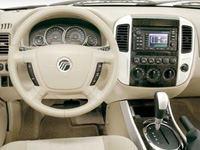 |
Standard equipment includes electric power-assisted steering (EPAS), disc brakes with anti-lock brake system (ABS), front foglamps and a rooftop rack, cabin air conditioning, power controls for windows and door locks and mirrors, a keyless entry system and driver-side keypad, six-way power controls on the driver's bucket, a leather-wrapped steering wheel with speed control tabs, and a stereo audio system with in-dash CD player for six discs.
A Premium Package brings leather upholstery and heated seats plus in-dash navigation system, while the Safety Package installs curtain-style side air bags and side-impact air bags for front seats.
Entry MSRP for Mariner Hybrid comes to $29,225.
| For more information visit the Lincoln-Mercury website here. |
| 2006 Mercury Mariner Hybrid HEV |
Description: |
Compact HEV SUV |
Model options: |
Mariner Hybrid |
Engine size: |
DOHC 2.3-L I4 + Magnet 70-kW Electric Motor |
Transmission: |
V6: Auto/5
V8: Auto/6 |
Wheelbase: |
103.2 inches |
Overall Length: |
174.3 inches |
Rear/Front Drive: |
Rear/front drive 4WD (AWD) |
Steering: |
Electric power rack and pinion |
Air bags: |
2 (front)
+ opt. 2 (side)
+ opt. 4 (side curtain) |
Fuel Economy: |
33/29 mpg |
MSRP: |
$29,225
|
|