Throughout the entire South, there is no place quite like Georgia’s Cumberland Island. It is almost poetic in its wildness, its waves echo against the shoreline with the whispered rhythm of a seagull’s wings, its great palmettos and oaks sway and sing in cadence with the ocean breezes of the nearby Atlantic.
 |
Reached only by private boat, private ferry from Fernandina Beach, Florida, or public ferry from St. Marys, Georgia, a historic waterfront town that is nearest the island, Cumberland is the epitome of natural beauty. Just less than eighteen miles long and only three miles wide, the diminutive island’s history and splendor are as deeply rooted as its mélange of forests.
Stepping on Cumberland Island is like stepping into the pages of a nature book. The largest and southernmost of Georgia’s barrier islands, Cumberland’s thick, unbroken canopy of treetops stretches across the island like tatted lace, hiding a cache of nature’s secrets: painted buntings, vibrant and jewel-like, flitting among the live oaks; raccoons skittering after fiddler crabs; armadillos sunning themselves on a sandy knoll; whitetail deer nibbling on a bed of clover; maybe even a bobcat shadowing its next meal of an unsuspecting field mouse.
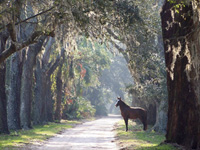
This is where quietness reigns, with the silence punctuated only occasionally by the bellow of an alligator, the high pitch of a passenger plane as it streams its way across the sky, or the clip-clopping and whinnying of a herd of feral horses, considered an exotic species on the island. The horses, along with a few feral pigs, were once a part of the plantation system of the island, but either escaped their pens or were completely abandoned by their owners. They have since bred outside of domestication, and upwards of 250 horses roamed Cumberland at one time or another.
The island’s topography, ideal for growing sea island cotton, indigo, and yellow pine during the “plantation era” before the Civil War, is diverse and divided into three separate phases: the salt marsh of its western end, the maritime forest—characterized by live oak and palmetto—that dominates it center, and the eastern beach.
The salt marsh, at first glance a not much more than a prairie of tall grasses striated with tidal rivers, comes alive with the quick movement of river otters, fat-beaked pelicans, slithery cottonmouth moccasins, and fiddler crabs. At daybreak, the marsh glows with all of the glorious colors of a tequila sunrise: pale pink, brilliant red, and subtle orange. The sunsets are even more magical; the marsh seems afire as it simmers and burns in golden shards of light.
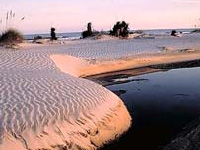
The marsh and forest soon meld gently into windswept dunes and wide expanses of beach and shoreline carved by tides and waves of the Atlantic. Just offshore, whales and dolphins dance in the water, and loggerhead turtles, imposing in size, trudge ashore along Cumberland’s 17 miles of unbroken beach to lay their eggs in the sugar-soft sand. Terns and seagulls soar overhead in the pure ocean air as feral horses gallop along the beach.
No doubt, this is natural beauty at its most rarefied.
 |
The first humans to enjoy Cumberland’s captivating beauty were probably the Timucuan Indians, who ruled until the Spanish came in the mid-1500s. The British were next in the 1700s, under the leadership of explorer General James Oglethorpe. Oglethorpe established a hunting lodge on the island, which he christened Dungeness.
After the American Revolution, war hero General Nathaniel Greene purchased land on Cumberland and made plans to build a mansion near Oglethorpe’s hunting lodge. Unfortunately he died before the home was built, and his wife, Catherine, remarried to a man named Phineas Miller. Together, they built the next Dungeness.
The Millers built the four-story Dungeness mansion of tabby -- Georgia’s “coastal concrete” that is a mixture of lime, sand, oyster shells, and water -- with six-foot thick walls at its base and 16 fireplaces. So grand was Dungeness that the “tourists” of the time used to boat over from the mainland just to see the home.
Cumberland then became home to several working plantations, but after the Civil War the plantation era on the island came to an end because there were no slaves to work the fields and keep up the homes. Dungeness slowly spiraled into deterioration, and the family moved away. In 1866, the once-stately mansion burned to cinders.
The entire island remained essentially neglected and abandoned until the 1880s when well-moneyed and industrious “Yankees” -- including the Rockefellers, Vanderbilts, and Pulitzers -- began buying coastal Georgia lands, including Cumberland, as private hunting retreats.
Thomas Carnegie, brother of steel magnate Andrew Carnegie, acquired Dungeness, and he and his wife, Lucy, rebuilt the home and landscaped the surrounding acreage in a series of trellised formal gardens. This became the third Dungeness, a 44-room, 40-building monolith that resembled a Scottish castle.
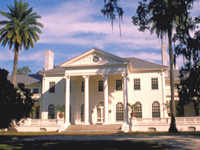
Although Thomas Carnegie died around the time Dungeness was completed, Lucy remained on Cumberland, offering to build homes on the island for each of her nine children, several of whom accepted her generosity. From there, Cumberland’s modern history sprang. The Carnegies built five homes, three of which still stand: Stafford Plantation, which is privately owned; Plum Orchard, owned by the National Park Service; and Greyfield, which has since been transformed into one of the most exclusive inns in America.
 |
As for the third Dungeness, it burned in 1959, this time not to be rebuilt. The charred skeleton of Dungeness remains on the island, but time, salt air, and sun have seared its bones to whiteness. Varmints like rattlesnakes and bobcats now lurk in the old tabby, making it seem almost unbelievable that Dungeness was once one of the largest and most splendid homes in any era of American history.
Greyfield was a wedding present from Lucy Carnegie to her daughter, Margaret, when she married Oliver Ricketson. The Ricketsons spent little time there, however, and the home came into main use about 1930 or so when they gave it to their own daughter, also named Lucy.
Lucy Ricketson Ferguson opened her home as Greyfield Inn in 1962, and since that time it has remained in Carnegie family hands. Greyfield looks much the same as it did when it was built around the turn of the century. Many of the same books are in place in the library, family portraits grace the walls of the parlor, and furnishings include Carnegie heirlooms. There are no telephones or televisions here, and although its wooden floors creak, its hallways are filled with the comforting smell of homemade bread and its wide verandahs and cushioned rocking chairs beckon you to lounge.
Cumberland once more came into prominence when John F. Kennedy Jr., married Carolyn Bessette at the island’s First African Church, and Greyfield, the only place outside of a campsite or private home with accommodations, enjoyed a new surge of publicity. While the just-wed Kennedys didn’t honeymoon at the inn—they stayed at a private residence—most of the wedding party did.
While the Carnegie family once owned most of Cumberland Island, only about 1,300 acres remain in the family, and most of that is around Greyfield Inn. The remaining acreage is now in the hands of the National Park Service and a smattering of island residents, who number around thirty to forty, depending on the time of the year. In addition to Greyfield, camping and hiking are allowed, but for no more than 300 visitors a day.
From its spellbinding beauty to its distinctive history, the hypnotic allure of Cumberland Island will serenade you into its soul forever.