Yuuum!
Taste this cheese!" offered Amy, a young journalist
from Toronto, before she nibbled away at another bite
of white cheddar. "I don't think I've ever had
cheese that tasted salty, sweet, and tangy all at
the same time. This is the best I've ever had!"
The cheese was exceptionally good, its intensely buttery
and spicy flavor unlike any domesticated brand found
on the grocery shelves of America. But perhaps that's
because it's locally handmade at Narbona winery on
the outskirts of Carmelo, on Uruguay's western river
coast.
 |
The
second smallest nation on the South American continent,
the pint-sized Uruguay, a relatively undiscovered
destination for Americans, lies in the central to
southern coastline of the Atlantic Ocean. Its neighbor
to the north is Brazil, while it bridges with Argentina
to the west and south. Uruguay's population, which
numbers around four million, thanks to its open-door
immigration policy, is steeped with European ancestry,
with nearly everyone descended from Spanish, Portuguese,
and Italian.
The capital of this diminutive country is Montevideo,
where most of the residents live, and which is home
to Carnaval, a spirited festival of costumed drummers
and street entertainers that takes place on the Monday
and Tuesday immediately preceding Ash Wednesday.
Any time of the year is great for a visit to Uruguay,
as it's never too hot or too cold, although high winds,
seasoned with the purest of air, sometimes ride in
from the Atlantic and mingle with breezes scented
with peppery eucalyptus and pine.
While just a few thousand feet of the ancient waters
of the Rio de la Plata separate the western edge of
Uruguay from Argentina, the two countries are nothing
if not worlds apart. While Argentina is fast, popping,
and sizzling with energy, Uruguay offers a quiet,
laid back strength that pulses with tranquility and
solitude amidst the muffled sounds of the South American
forest or the clatter of an old pickup truck, its
bed overloaded with fruit, as it winds its way down
a dirt road bound for the farmers market or a roadside
stand.
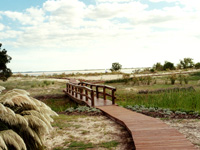
Uruguay's natural beauty is quite unexpected, and
the tapestry of its coast along the Rio de la Plata
- known in English as the "river of silver"
- is embroidered with a cache of surprises: tiny villages
brimming over with antiques and artwork, bicycle and
walking trails that reveal the hushed splendor of
the countryside, wineries that produce aromatic and
flavorful wines, and even a casino or two complete
with the "ka-ching-ka-ching-ka-ching" of
slot machines.
The
river, running 220 miles along Uruguay's fertile coastal
lowlands, is the widest in the world. An ecologist's
dream, it is stunning in its simplistic beauty. Its
silty waters are paint-brushed and swirled with cinnamon,
gingerbread, and pumpkin, and here and there the ebb
and flow of the currents carve a scattered archipelago
of rich, green islands and sea-polished sandbars.
A mélange of water birds dance and skitter
on the river's edge, their stilted legs holding strong
against the tide. The river leads to several small
villages that are worth exploring, including tree-infused,
well-shaded Colonia.
Marked by a lighthouse whose cupola defines the harbor,
Colonia, dating back to the 15th century, is an amalgamation
of narrow cobblestone and brick streets, antique and
curio shops whose open doorways jangle with the lullaby
of homemade wind chimes, and lively restaurants and
bistros painted anywhere from shocking pink to canary
yellow.
Colonia tells the story of Uruguay, its fight for
independence from Spain and Portugal, and its deep
maritime links to the past. With its colonial architecture
and profusion of vibrant flowers - a variety of hibiscus,
fuchsia-tipped four o'clocks, and scarlet-dipped geraniums
line the streets - exploring its Old World ruins,
harbors, and churches is an exercise in both romance
and history.
If
Uruguay in itself is an ecologist's dream, then the
village of Carmelo, just across the Rio de la Plata
from Buenos Aires, is an antique car collector's dream.
Preservation of classic automobiles from the 1920s,
1930s, and 1940s seems to be a pastime here, and it's
entertaining in and of itself just to search out the
old cars on the town's colorful squares. But Carmelo's
real intrigue is that the town was once a center for
bandits and smugglers, which only somehow seems fitting
that it now houses one of the area's glittering casinos.
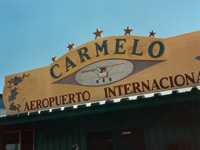
Carmelo
is also becoming a center for wine. The climate, with
its cool evenings and warm days, is perfect for growing
grapes, and the boutique wine industry - and in some
cases, as with Narbona, the cheese industry - has
really exploded over the past few years. With the
backdrop of vineyards heavy with chardonnay and Shiraz
grapes dappling the sun-baked hillsides around the
town, you might want to sample a glass of vino at
one of the local restaurants.
These
small villages and the entire coast of Uruguay are
idyllic for long bicycling or hiking jaunts. In the
summer, you can pedal or walk past mosaic pastures
of sunflowers and fields of ripening corn that are
brightly woven against the gossamer-blue sky. Since
there is little or no traffic - except the occasional
rattle of a horse and cart as it hobbles down the
terra cotta clay roads - listen carefully, for in
the distance, the forest trembles with the calls of
exotic birds. This is the essence of Uruguay and what
she has to offer.
Of course, you need a place to stay as you explore
Uruguay. Accommodations run the gamut on the coast,
but with the American dollar at a premium, you can
pamper yourself at a full-service resort and spa like
the Four Seasons, which is set directly on the Rio
de la Plata.
The Four Seasons is the quintessential South American
experience. Set deeply amid tall pines and fragrant
eucalyptus, the woods are also stippled with an occasional
Paradiso tree, its branches thick with birds and blossoms.
The vast acreage of the Four Seasons, with its world-class
(and toe-curling!) spa, golf course that seems destined
to be one of the world's best, and back-to-nature
outdoor showers, is the perfect place for learning
about more about local birds, trees, and flowers.
Drawing luminaries such as Robert Duvall, the resort
is a great home base for exploring Uruguay's river
coast.
As you traverse Uruguay's tranquil, green pastures
and rural com-munities, you realize there are still
places that are untouched and undeciphered by humans.
And right now, it's not a bad place to be.
IF
YOU GO... |
For more information, visit www.turismodeluruguay.com.
Contact the Four Seasons by visiting the website
at www.fourseasons.com or calling reservations toll-free at (800) 332-3442.
Contact American Airlines, which offers excellent
fares and schedules through Buenos Aires, by
visiting the website at www.aa.com or by calling toll-free at (800) 433-7300.
|